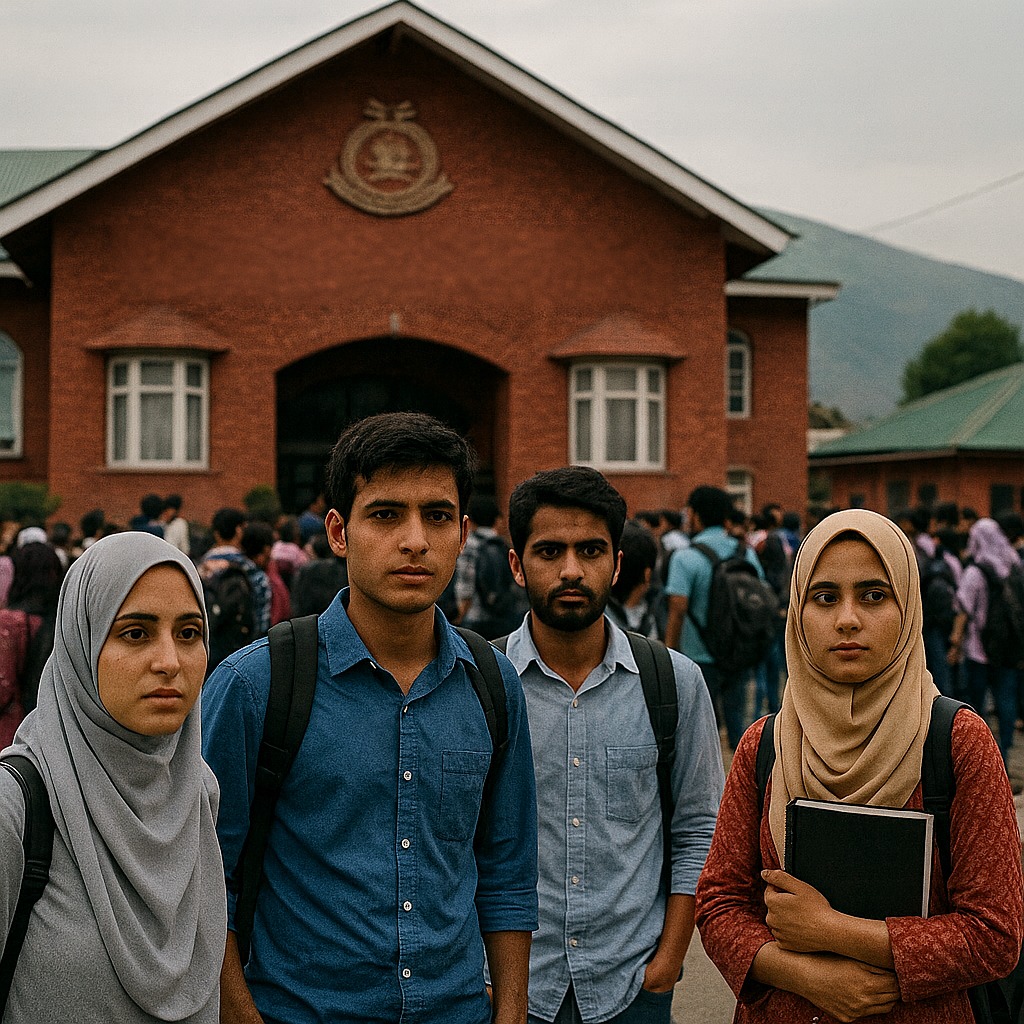
The discussion on public policy in peripheral territories like Jammu and Kashmir has always been shaped by domestic, strategic, and structural factors. However, amid these complexities, the landscape of higher education in Jammu and Kashmir in particular and India in general has grown into one of the world’s largest systems, reflecting both its scale and ongoing transformation.
According to the All India Survey on Higher Education, total enrolment in higher education reached nearly 4.33 crore students in the 2021 to 2022 academic year, rising from 3.42 crore in 2014 to 2015. The Gross Enrolment Ratio for the eighteen to twenty-three age group also increased from 23.7 percent to 28.4 percent during the same period. Equally significant is the rise in female participation, which grew from about 1.57 crore to 2.07 crore, signalling steady progress toward gender inclusion. These figures underscore the impressive numerical gains India has achieved in expanding educational access.
Yet this rapid expansion has raised new questions about quality, governance, and the true purpose of higher education. College access is now far more widespread, but the learning environment, institutional accountability, and the connection between education and employability have not advanced at the same pace. This national pattern is reflected sharply in the Union Territory of Jammu and Kashmir, where higher education has become both an achievement in terms of reach and a challenge in terms of depth. The region’s universities and colleges have multiplied, but the governance frameworks and academic culture needed to sustain excellence have lagged.
Structural Imbalances in Jammu and Kashmir
The Gross Enrolment Ratio in higher education in Jammu and Kashmir currently stands at around 32 percent, slightly above the national average. This is a noteworthy accomplishment for a region that has historically faced geographical, political, and infrastructural constraints. The number of universities has crossed ten, including central, state, and private institutions. Alongside this, more than 140 government degree colleges have been established across the Union Territory, many within the past decade. These developments reflect a determined effort by policymakers to make higher education accessible, particularly to students from rural and semi-urban areas.
The overall student enrolment in higher education institutions across Jammu and Kashmir is 287,663. This includes 9,274 at the University of Jammu, 13,375 at the University of Kashmir, 198,392 in government-run colleges, and 56,644 in private colleges. The growth in female enrolment is a positive indicator. Social attitudes toward women’s education are gradually changing, and policy initiatives encouraging inclusion have yielded measurable results. At the undergraduate level, gender parity is improving, marking a shift in the region’s educational culture.
However, when examined more deeply, this expansion reveals major structural weaknesses. The transition from undergraduate to postgraduate education remains fragile. Despite an increase in the number of institutions offering postgraduate degrees, enrolment at this level is considerably lower. Many students either lack academic preparedness or do not see clear economic or intellectual value in continuing their studies. As a result, the academic pipeline narrows significantly after graduation, leaving postgraduate programs underpopulated and underperforming.
Data from the Directorate of Employment in Jammu and Kashmir shows that around 3.52 lakh young people were registered as unemployed during the first quarter of 2024. Among these, about 1.09 lakh hold graduate or postgraduate degrees, representing roughly 31 percent of the unemployed population. Reports from the Centre for Monitoring Indian Economy indicate that the youth unemployment rate in the region has remained between 20 percent and 25 percent in recent years, ranking among the highest in the country. This data exposes a clear mismatch between higher education output and labour market absorption.
The reality that a large proportion of the unemployed are educated young people, including those with professional degrees, points to a profound disconnect between academic qualifications and employability. Many students pursue degrees hoping for secure employment, yet the system often fails to equip them with the skills demanded by modern economies. The curriculum remains largely theoretical and disconnected from practical applications, research opportunities are limited, and faculty recruitment is inconsistent. As a result, the region produces graduates who are credentialed but not necessarily career-ready.
A closer look at institutional dynamics reveals that the expansion of infrastructure has not been matched by a proportional rise in academic quality. The creation of new colleges has often outpaced the appointment of qualified faculty, the development of modern curricula, and the establishment of strong governance systems. This imbalance has produced a network of institutions that exist in form but struggle in function. The focus has remained on quantitative expansion rather than qualitative improvement, leading to the diffusion of resources and a decline in institutional depth.
Baba Ghulam Shah Badshah University in Rajouri provides a telling example of these governance challenges. The university has been under public scrutiny for administrative inertia, faculty shortages, and a decline in academic standards. These problems are not isolated since they reflect broader governance weaknesses across the higher education landscape of Jammu and Kashmir. Delayed recruitment, limited transparency, and weak accountability mechanisms have become systemic. When governance falters, the cascading effects are experienced across the entire academic ecosystem, which compromises teaching quality, research innovation, and student experience.
Besides domestic factors, regional structural security concerns also influence the educational landscape in Kashmir. A recent study has found that protracted armed conflict has profoundly weakened education in Jammu and Kashmir by disrupting schooling, damaging student well-being, and undermining institutional stability. Stakeholder surveys highlight how persistent insecurity, closures, and psychological stress have eroded learning environments and academic performance. Children experience heightened trauma and reduced classroom engagement, while educators struggle to maintain continuity and support. The research underscores the need for peace education initiatives that can rebuild trust, resilience, and constructive dialogue within schools. It also argues that meaningful recovery in the education sector requires structural reforms that address the wider political, social, and economic instability shaping daily life in the region.
Governance Deficit and the Path to Reform
The core challenge facing higher education in Jammu and Kashmir lies in governance. Institutions have grown in number, but the structures guiding their management and accountability have not evolved to meet contemporary demands. Governance failures manifest in three critical areas: policy implementation, faculty management, and institutional vision.
First, the absence of timely decision-making and consistent policy execution weakens institutional performance. Recruitment processes are often delayed, appointments remain pending for years, and administrative hierarchies are burdened by procedural bottlenecks. Without agile and transparent governance systems, even well-intentioned reforms lose momentum.
Second, chronic faculty shortages have become a defining feature of the crisis. Reports from institutions like BGSBU show that more than 60 percent of sanctioned teaching posts are vacant, including all full professorships. This shortage erodes the teaching learning process, limits mentorship opportunities, and stifles research productivity. Students in such environments often face large class sizes, limited academic guidance, and fewer opportunities for intellectual growth.
Third, the lack of institutional vision is evident in the disconnection between curriculum design and regional economic priorities. Courses rarely integrate skill-based learning or local development concerns such as tourism, horticulture, renewable energy, and cultural industries. These sectors hold substantial potential for sustainable employment. Without aligning education with the regional economy, institutions risk producing graduates who are theoretically informed but practically excluded from relevant job markets.
Addressing these deficits requires a comprehensive and multi-level reform strategy. Universities must adopt transparent recruitment processes and establish performance-linked evaluation systems for both faculty and administrators. Decision-making should be decentralized, empowering departments to innovate within broad policy frameworks. Governing bodies should include external experts from academia, industry, and civil society to ensure broader accountability and relevance.
Curricular reform is another crucial component. Institutions should redesign postgraduate programs to include project-based learning, interdisciplinary collaboration, and partnerships with industries. Courses should focus on critical thinking, digital skills, and research exposure. Internships and community engagement projects can bridge the gap between theoretical instruction and real-world application. These interventions would not only improve employability but also restore purpose to higher education.
Equally important is investment in capacity building. Instead of spreading resources thinly across numerous institutions, the government should prioritize strengthening a few key universities as centres of excellence. These institutions can serve as models of governance and academic integrity, setting benchmarks for others to follow.
Way Forward
The way forward lies in transforming expansion into excellence. This transformation will depend on strengthening governance, improving faculty capacity, modernizing curricula, and linking education more closely with the regional economy. Above all, it requires restoring faith in higher education as a vehicle for intellectual development and social empowerment.
If Jammu and Kashmir can rebuild its higher education governance around transparency, accountability, and innovation, it can transform its universities into engines of progress rather than symbols of stagnation. The challenge is immense, but so is the potential. The future of the region’s higher education depends not only on the number of universities it builds but on the values of integrity, inclusion, and inquiry that these institutions choose to uphold.
Reforming higher education governance in Jammu and Kashmir also demands a cultural shift in how education is perceived. The purpose of higher education must move beyond obtaining degrees toward fostering intellectual curiosity, civic responsibility, and innovation. A meaningful education system cultivates both the mind and the skills necessary for social progress.
The region’s universities must become spaces of critical inquiry rather than bureaucratic routine. To achieve this, they need robust leadership, transparent governance, and a commitment to academic autonomy. Leadership positions should be filled through merit based selection processes, free from political interference. Digital governance platforms can help streamline administrative processes, monitor faculty performance, and enhance public accountability.
Institutional partnerships can also play a transformative role. Collaborations with national and international universities can bring in new ideas, joint research initiatives, and faculty exchange programs. These alliances can help overcome the isolation that often limits the academic development of regional universities.
In addition, the region should prioritise building a strong research ecosystem. Currently, most universities in Jammu and Kashmir produce limited research output due to a lack of funding, mentorship, and infrastructure. Establishing dedicated research grants, innovation hubs, and doctoral support systems would create an environment where inquiry and creativity thrive.
Conclusion
Higher education in Jammu and Kashmir stands at a decisive juncture. The region has achieved significant progress in expanding access, yet it continues to grapple with fundamental challenges of quality, governance, and purpose. The growing unemployment among educated youth and the weak connection between degrees and employability reveal the urgent need for systemic reform. In addition, strengthening higher education in Jammu and Kashmir will require embedding peace-oriented learning approaches that foster trust, resilience, and open dialogue across campuses.
References
-
https://www.greaterkashmir.com/opinion/postgraduate-education-in-kashmir-failure-and-the-future/
-
https://risingkashmir.com/jk-records-highest-number-of-3-52-lakh-unemployed-youth/
-
https://www.jkpi.org/what-the-bgsbu-crisis-reveals-about-higher-education-governance/
-
-
https://thekashmirhorizon.com/2025/05/06/has-higher-education-in-jk-hit-a-dead-end/
-
https://www.tandfonline.com/doi/full/10.1080/17400201.2024.2433783
-
https://education.economictimes.indiatimes.com/news/higher-education/60-faculty-posts-vacant-at-jks-baba-ghulam-university-overburdened-junior-professors-hold-fort/123149912



Leave a Reply
You must belogged in to post a comment.