
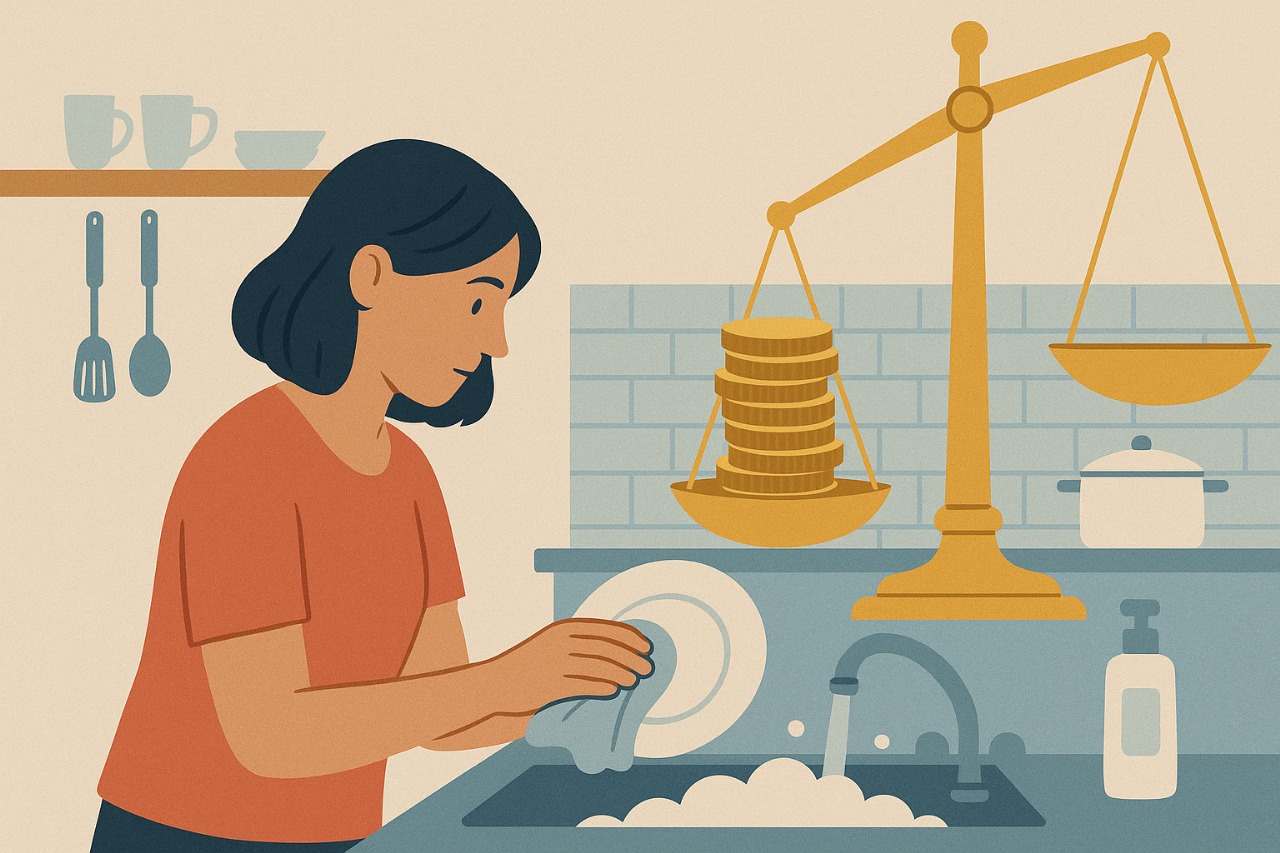
The movement demanding wages for housework aims to recognise the impact that labour done by housewives ultimately has on the economy, which is otherwise completely invisible. This commentary examines the struggles of housewives, the philosophy behind compensating them, and the methods used to calculate wages for care work.
16.4 billion hours per day are spent performing unpaid care labour, as per data from the International Labour Organisation, which is based on two-thirds of the world’s working-age population. In other words, that is 2 billion people working 8 hours every day without pay. Interestingly, if these services were to be monetised, they would contribute to 9% of the world’s GDP or US$11 trillion. In spite of such immense labour, domestic labour remains unpaid and often unacknowledged.
For this reason, the global movement demanding wages for housework seeks to bring visibility and recognition to the immense contribution that women’s unpaid domestic and care labour makes to the economy.
Why does care work need to be remunerated?
Whilst the economy of unpaid care work has remained largely invisible for hundreds of years, the demand for its recognition has roots stretching back to the 19th Century, when the first wave of women’s rights movements in the US, Britain, and Europe occurred.
At this time, one of the most prominent issues plaguing women was that the burden of housework completely restricted them to the household. Added to this was the “second-shift” problem; working women had to manage not only labour outside the household but also within the household.
Following this, in the second wave movement, the focus of protests was not so much on the restrictions or burdens that came with housework, but the fact that it was unpaid and thereby perceived as a tool of oppression. In Silvia Federici’s words in Wages Against Housework, the unpaid element that is intrinsic to housework is a ‘powerful weapon’ in reinforcing the notion that such work is not “actual work”. And, it is this reasoning that prevents women from opposing it with the exception of household kitchens or during bedroom quarrels, which have become a matter of ridicule in society over time.
Dr Roshan Ara, Assistant Professor at the University of Kashmir’s Centre for Women’s Studies & Research, highlights some major arguments that are raised in the context of the wages for housework movement: ‘This [care work] is the pillar of the economy…if housewives do not work for one day, the whole world will be stagnant…there will be confusion and chaos…Who is preparing this human resource? It is the mother. Therefore, I think this whole economy, wholly and solely, is being supported by women.’
This is akin to the ‘social reproduction theory’ propagated by Marxist feminists, who view women’s housework as a part of the social reproduction process, which argues that, in reality, housewives enable men to perform their labour by providing food, care, emotional support, and so on to them. Not only this, a Marxist feminist would also go so far as to point out that the capital class extracts unpaid labour from women in an exploitative fashion.
Challenges with remunerating housework
So if it were to be decided that housewives should be paid for their carework, a significant challenge there would be in doing so would be to decide how their wages are to be calculated. The United Nations System of National Accounts in 2008 listed the challenge of deducting ‘economically meaningful estimates of their values’ as one of the reasons for not including unpaid care work in labour statistics.
This is because a primary challenge lies in distinguishing between work and leisure activities. For instance, if a mother is playing with her child, would she be considered to be enjoying or working? If considered to be a leisure activity, any claims of exploitation of the woman would be dismissed. But, if this is considered as work, then one can take the number of hours that childcare is performed and compare it with the working hours that the husband performs to ensure that the productive and non-productive working hours of both partners are equal, and thus, neither is exploited.
Now, if we suppose that childcare is both a productive and non-productive activity, it would be categorised as work only to the extent that it contributes to the psychological growth of the child. And, since there is no clear standard by which we can separate work from non-work, norms of fairness are tricky to apply when it comes to the separation of work between men and women.
But in such cases, women can be asked to decide for themselves what type of work they believe constitutes leisure and labour. Although, as the “second-shift” concerns in the second wave movement suggest, there may be a possibility that women see household work as largely cumbersome. Nevertheless, such perceptions can shift over time, and the say of women would be crucial in determining this.
Calculating the wages
One formula for calculating wages would be to take into consideration all the household work that can be outsourced to nannies, gardeners, cooks, domestic help, etc. and use it as a maxim to calculate the cost of the work that housewives would do in their place. This is the input evaluation method.
Another method can be based on the notion that all the work performed by women within the household is aimed towards the betterment of her family members, who are human capital. Hence, women should be compensated accordingly. This is called the output evaluation method, whereby the market value of a task is calculated on the basis of the goods that it produces.
Understanding the social impact of unpaid housework
Whilst care work has its intricacies in terms of monetisation, there is one aspect of this debate which is imperative to address, and that is the bargaining power that lies with women, as Dr Ara points out: ‘When it comes to monetary power, when it comes to bargaining power — within the household, who has the bargaining power? The bargaining power is in the hands of the person who has the cash in hand, who has resources in hand. And this “resource-lessness” has degraded women; it has reduced their status as they have no bargaining power and no decision-making power. For example, in any family, whatever bold decision has to be made, usually some men assume that women’s decisions do not matter because they are not earning.’
In many families, women do not possess any decision-making power, as it lies primarily in the hands of men who are viewed as economic contributors. Dr Ara is of the strong opinion that men’s ability to perform productive labour outside the household is a direct result of women’s unpaid labour. ‘I am of the firm opinion that if we cannot [remunerate women], it is not necessary that men have to pay for this. But at least men should get this realisation that whatever they are doing outside the home, it is all because women are giving them their time. She can also earn, but she is playing such a great role, she is preparing a human resource for the economy, she is feeding the members of the family…we need to value this work’
Overall, the debate on women’s right to wages for carework is not merely an economic concept; it targets acknowledgement, redistribution, and dignity. Whether as a matter demanding discussions on the calculation of wages, social recognition or wider social policy reforms, it requires sustained input from researchers, legislators, and, of course, the general public.
Bibliography
https://www.ilo.org/asia/media-centre/news/WCMS_633284/lang–en/index.htm
https://plato.stanford.edu/entries/feminism-class/#FirsWaveFemiAnalWomeWork


Leave a Reply
You must belogged in to post a comment.