A physicist was once asked to define foolishness. He said, “When a person repeats the same experiment with similar inputs again and again, but expects a different outcome each time, I call it foolishness.” Albert Einstein or perhaps Rita Mae Brown further refined and crystallised this assertion, saying that “insanity is doing the same thing over and over again and expecting different results.”
This description fits well with Jammu and Kashmir’s repeated encounters with avoidable tragedies.
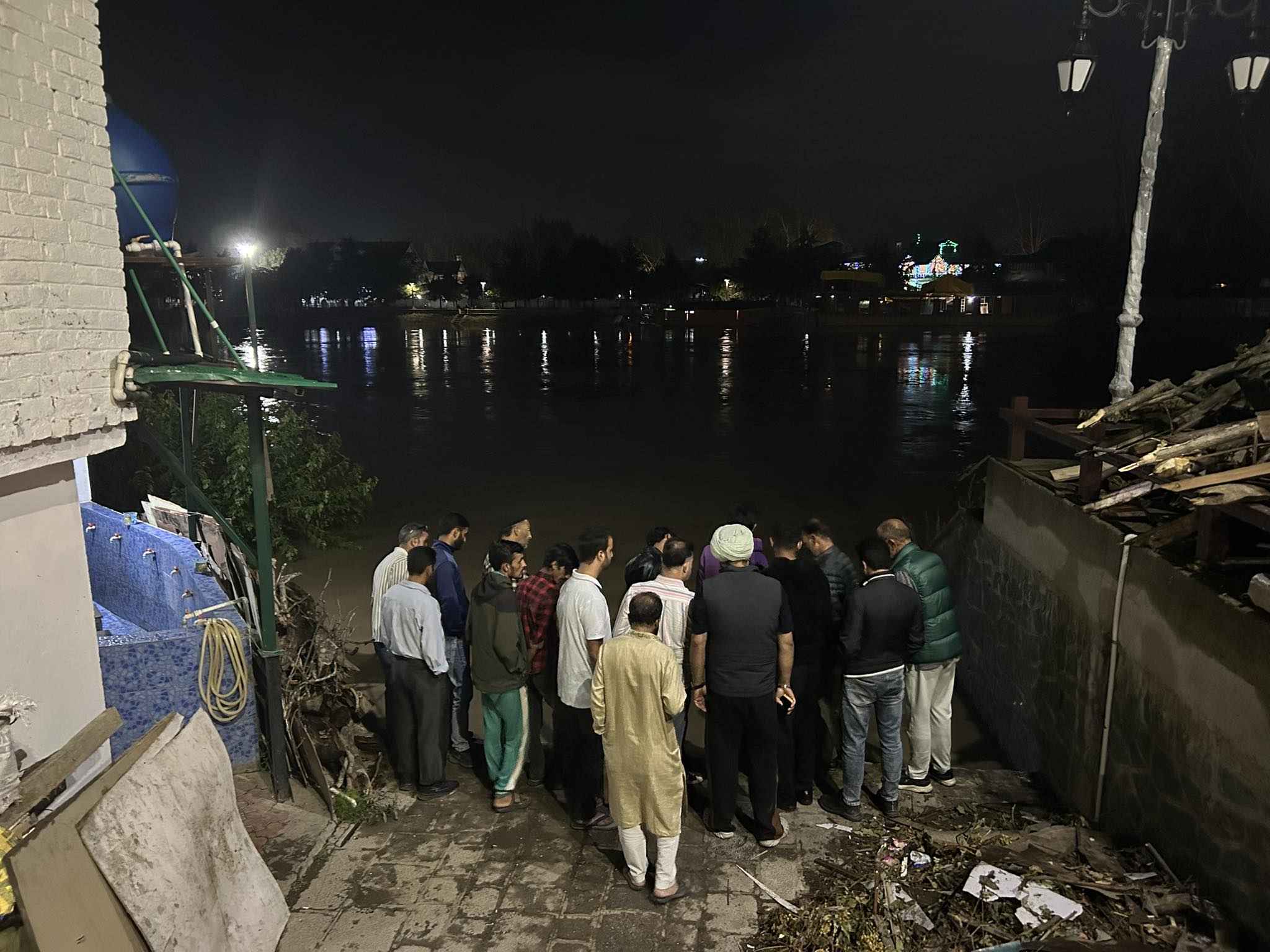
On Wednesday night, the two banks of the Jhelum in Srinagar turned into the city’s most crowded and anxious spaces, as thousands of residents gathered to watch the river swell above the danger mark, a sight that revived terrifying memories of the devastating September 2014 floods. The water crossed the danger mark at Sangam and touched the warning level at Ram Munshi Bagh for the second time this year, leaving the safety of Kashmir hanging by a thread. People now fear even a normal rainfall, knowing that there are still no proper flood channel arrangements in Srinagar.
That fear was not unfounded. Early Thursday, a breach in the Jhelum embankment near Zoonipora village in Budgam led to flooding in several adjoining areas, forcing the district administration to launch overnight evacuation and relief operations. Villages, including Shalina, Rakh Shalina, and Baghi Shakirshah, were inundated, with residents being shifted to designated rescue centres and safer locations.
Eleven years after the 2014 deluge, which inundated nearly 850 sq km of Kashmir, submerged parts of Srinagar under six meters of water for weeks, and caused untold devastation, the Jhelum’s flood-carrying capacity remains woefully inadequate. No dredging of the river or its spill channels has been carried out in the last five years, raising uncomfortable questions about the flood mitigation measures that authorities continue to claim, such as comprehensive dredging of the Jhelum and its tributaries, restoration of wetlands and flood channels, construction of an alternate flood channel, and strengthening of embankments.
To his credit, Omar Abdullah did not shy away from acknowledging the gravity of the situation. He openly admitted that just two days of rain had brought Kashmir to the brink of another disaster, contrasting it with the week-long rainfall in 2014 that culminated in the valley drowning on the eighth day. Stressing that people cannot be left to live in constant fear of floods every year, he said his government would sit with the administration to seek answers on what measures were actually taken after the 2014 deluge. “Where was the money spent? How much carrying capacity of the flood channel was increased? How much did we succeed in increasing it through dredging in the Jhelum? We have to take corrective measures wherever we are lagging,” he told reporters.
But the answers, when unearthed, are damning. A Right to Information (RTI) response to noted environmentalist M.M. Shujah has revealed that between March 2020 and March 2025, no dredging or silt clearance was undertaken in the Jhelum or its flood spill channels. The last major “capital dredging” exercise was conducted by a Kolkata-based private company before 2020; since then, not a single new contract has been signed. Meanwhile, encroachments continue to choke the river: over 6.3 lakh trees, 1,884 unauthorised constructions, and 283 concrete walls obstruct the natural flow. Experts have repeatedly warned that unless systematic dredging resumes, encroachments are cleared, and flood management plans are completed, the Valley is staring at a repeat, or worse, of 2014.
The bigger question, however, is what happened to the Rs 80,000 crore financial package announced by the Central government after the 2014 deluge for flood mitigation. Was that money ever released, in part or in full? If yes, how much was actually spent for the stated objectives, and with what outcome, if any? Officially, the Irrigation and Flood Control Department claims that 80% of the Comprehensive Flood Management Plan has been completed, but on the ground, little has changed.
The numbers tell their own story. On September 3 this year, the flood level at Ram Munshi Bagh in Srinagar was the highest since the 2014 floods. Since then, the Jhelum has crossed the Flood Declaration Mark 11 times, almost one major flood every year. From the repeated surges in 2015 to the floods of 2017, 2018, 2022, 2023, and the most recent one in 2025, the pattern is painfully clear: the Valley remains as vulnerable today as it was eleven years ago.
The floods that devastated the Jammu region last week, while simultaneously threatening Kashmir, clearly show that the aims of the 2014 financial package were never achieved in the scientific or planned manner required. Yet once again, J&K leaders are seeking another financial package, with Deputy Chief Minister Surinder Choudhary and opposition leader Mehbooba Mufti both pitching for “a good financial package for the people affected with floods and landslides across the UT, especially in Jammu division.”
But if the new aid, too, is handed over to the same institutions and officials who mishandled the last one, why should anyone expect different results?
Maybe now is the time to ask: why repeat the same experiment with the same inputs again and again, yet still expect a different outcome? Foolishness, after all, must have its limits. Negligence with such a deadly cost, however, can no longer be excused as mere foolishness.



Leave a Reply
You must belogged in to post a comment.