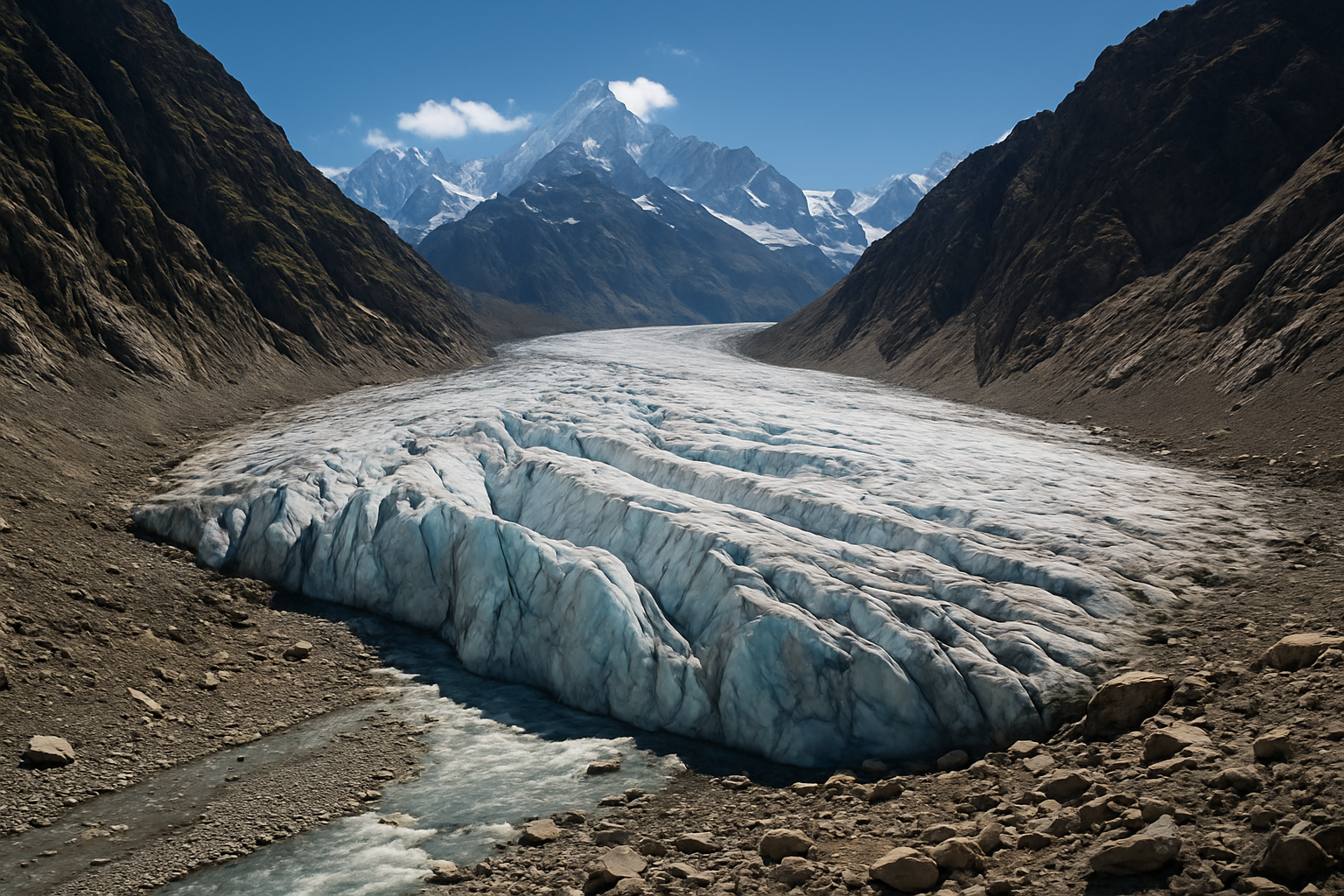
Jammu and Kashmir is renowned for its spectacular glacial cover, which serves as a critical source of water for the region. The Jammu Region, Kashmir Valley and Ladakh alone are home to nearly 18,000 glaciers, particularly in the Himalayan ranges, feeding major rivers such as the Jhelum, Chenab, and Indus. The region’s northernmost location in India, marked by majestic Himalayan mountains, endows it with extensive glacial resources.
Significant glaciated zones are found in the Karakoram, Zanskar, Pir Panjal, and Ladakh ranges. These glaciers play a vital role in sustaining freshwater supplies. However, like many glacial systems around the world, the glaciers in Jammu & Kashmir are experiencing accelerated melting due to rising global temperatures and climate change. This alarming trend threatens the region’s ecological balance, socio-economic stability, agriculture, and overall water security.
Accelerating Glacier Retreat in J&K
Glacial retreat, the shrinking of glaciers due to climatic and environmental changes, has reached alarming levels in Jammu and Kashmir, leading to a significant loss of vital water resources. This rapid retreat underscores the growing impact of climate change on the region’s fragile mountainous ecosystems and is triggering cascading effects on downstream water availability. Scientific studies conducted by the Wadia Institute of Himalayan Geology and the Indian Space Research Organisation (ISRO) reveal that over 18% of the region’s glaciers have retreated in recent decades.
- The Kolahoi Glacier, a major glacier in the West Lidder Valley near Pahalgam, has shrunk by 24% in area and 50% in volume since the 1960s. It has retreated 2.9 km between 1963 and 2005, which translates to around 16 meters annually.
- In Kishtwar, glaciers have reduced by 8.8% in area, approximately 3 km from 1980 to 2020.
- Monitoring of 65 glaciers between 1998 and 2014 showed a total loss of 32 km² of glacier area, with glaciers in the Greater Himalayas retreating at about 0.36% per year.
The study titled “Glacier Inventory of Himalayas” (2011–2021) by ISRO and the National Remote Sensing Centre tracked over 2,000 glaciers, confirming consistent loss across the Western Himalayas (part I in J&K).
- According to the Geological Survey of India (GIS), Thajiwas Glacier in Sonmarg retreats by 3–5 meters annually.
- The Chenab basin is vulnerable, with projections indicating a 25% reduction in river flow by 2050.
- Multiple findings by the Jammu University Research (Department of Geology and Environmental Sciences) have found that Pir Panjal Range glaciers are retreating fastest, losing about 1 meter annually, whereas Karakoram glaciers lose only around 10 cm per year.
While both the Pir Panjal and Karakoram ranges are witnessing significant glacial loss, the rate of retreat is notably higher in the Pir Panjal range. This contrast highlights the uneven pace of glacial melting across the region, influenced by factors such as slope gradient, debris cover, glacier size, and localised microclimatic conditions. A 2020 satellite-based study, which assessed approximately 12,243 glaciers across Jammu and Kashmir and Ladakh, reported an average annual mass loss of 35 cm water equivalent, amounting to a total loss of nearly 70 gigatonnes during the study period. This rapid glacial retreat poses serious risks to the region’s water supply, agriculture, and biodiversity, and significantly increases the threat of Glacial Lake Outburst Floods (GLOFs).
Climate Drivers of Glacial Retreat in J&K
While multiple factors contribute to glacier loss, climate change remains the most significant driver. The Hindu Kush Himalaya (HKH) region, including Jammu and Kashmir, has seen average warming of 0.2°C per decade, twice the global average.
- A declassified satellite study found ice loss in the Himalayas has doubled since the 1970s.
- According to The Tribune, the snow surface temperature in the Himalayas rose by 4°C between 2000 and 2023.
- Reduced snowfall and altered precipitation patterns—notably in glaciers like Kolahoi—have further limited snow accumulation, declining by 1 cm per decade (1979–2013).
Another major contributor is black carbon—a pollutant from biomass burning, diesel exhaust, and residential combustion.
- ISRO and NASA data show increased black carbon concentrations, raising snow surface temperatures by up to 4°C.
- ICIMOD attributes 28% of pre-monsoon glacier melt in the HKH region to black carbon.
- Aerosol pollution from the Indo-Gangetic Plain contributes to 50% of observed atmospheric warming.
Urban heat islands in cities such as Srinagar, Jammu, and Leh have contributed to a localised temperature rise of approximately 2°C. This increase indirectly accelerates glacial melt by transmitting heat to surrounding upland areas. As a result, the region is experiencing earlier snowmelt, shorter snow seasons, and diminished runoff, threatening fragile ecosystems, agricultural productivity, and long-term water security.
Cascading Impacts of Glacial Retreat
Glacial melt has far-reaching impacts beyond water availability:
- Water Resources: Glaciers regulate water flow by releasing meltwater in the summer. With their retreat, seasonal water availability has become erratic. The River Jhelum has seen a more than 50% decline in water levels (2025) due to rising temperatures and prolonged dry spells. ICIMOD (2021) found the Jhelum had 20–30% more flow in early spring but 15% less in mid-summer, disrupting water use patterns.
- Agriculture: Agriculture in J&K, especially paddy, maize, and barley, is heavily glacier-dependent. Drought-like conditions, delayed sowing, and increased groundwater dependency are becoming common. The Wadia Institute estimates 80% of irrigation in the upper Chenab basin comes from glacier-fed sources.
- Hydropower: Rivers like Chenab, Jhelum, and Kishanganga power several NHPC plants. The glacial melt causes short-term surges in spring but deficits in summer, affecting turbine efficiency and output. A report published by CWC revealed a 10–15% drop in output during July–August, impacting power supply and dam stability.
- Perennial Springs and Biodiversity: Of the 2,500 glacier-fed springs, 30% have dried up, especially in Kupwara, Pahalgam, and Kishtwar. The biodiversity is under threat, with alpine flora shifting upward and wildlife corridors disrupted due to warming.
- Glacial Lake Outburst Floods (GLOFs): Over 180 glacial lakes in J&K and Ladakh are at high risk. GLOFs caused by melting, heavy rain, or earthquakes can result in flash floods, infrastructure damage, and biodiversity loss. The 2010 Leh cloudburst, 2014 J&K flash floods, and 2021 Rumbak GLOF are some of the historic examples.
Policy and Response
A multi-pronged, science-backed policy response is essential:
- Monitoring & Early Warning, followed by the expanded satellite monitoring and field campaigns for glacier health and lake development. The implementation of the annual glacier melt indices as performance indicators at the state level must be considered.
- Disaster Risk Reduction must integrate glacier melt and GLOFs risk into district disaster management plans. The installation of hydrological sensors in high-risk zones and the development of evacuation protocols, community drills, and lake-draining engineering solutions to check the overflow channels remain important.
- National & State Climate Policy Alignment: There must be a strengthening of the National Mission on Sustaining the Himalayan Ecosystem (NMSHE) under the NAPCC. The State Action Plan on Climate Change for J&K must prioritise the Glacier monitoring, Nature-based solutions, River restoration, and Afforestation in upper catchments.
- Research & Collaboration: It it’s important to establish collaboration with institutes like Wadia Institute of Himalayan Geology, ICIMOD, ISRO, and local universities to promote data sharing, glacial inventory updates, and public awareness campaigns.
Conclusion
Glacial melt in Jammu and Kashmir stands as a stark indicator of the intensifying impacts of climate change on fragile mountain ecosystems. Without urgent and sustained action, the region risks facing cascading consequences, ranging from water scarcity and agricultural disruption to more frequent natural disasters and ecological collapse. Addressing these challenges demands a coordinated approach that integrates scientific research, policy reforms, disaster preparedness, and active community participation. Only through such a comprehensive strategy can the region’s environmental integrity and economic future be safeguarded.
References
Linking the Recent Glacier Retreat and Depleting Streamflow Patterns with Land System Changes in Kashmir Himalaya, India https://www.researchgate.net/publication/340757115_Linking_the_Recent_Glacier_Retreat_and_Depleting_Streamflow_Patterns_with_Land_System_Changes_in_Kashmir_Himalaya_India
Modelling of Snow Cover Area in Relation with Climatic Variability over the Sind Basin of Kashmir Himalayas (2002–2022) https://www.sciencedirect.com/science/article/abs/pii/S1474706524003012
Impact Analysis of Climate Change on Kolahoi Glacier in Liddar Valley, Northwestern Himalayas https://www.researchgate.net/publication/310278266_Impact_analysis_of_climate_change_on_Kolahoi_Glacier_in_Liddar_Valley_north-western_Himalayas
Glacier Thickness and Volume Estimation in the Upper Indus Basin Using Modeling and Ground Penetrating Radar Measurements https://www.researchgate.net/publication/377424289_Glacier_thickness_and_volume_estimation_in_the_Upper_Indus_Basin_using_modelling_and_ground_penetrating_radar_measurements


Leave a Reply
You must belogged in to post a comment.